
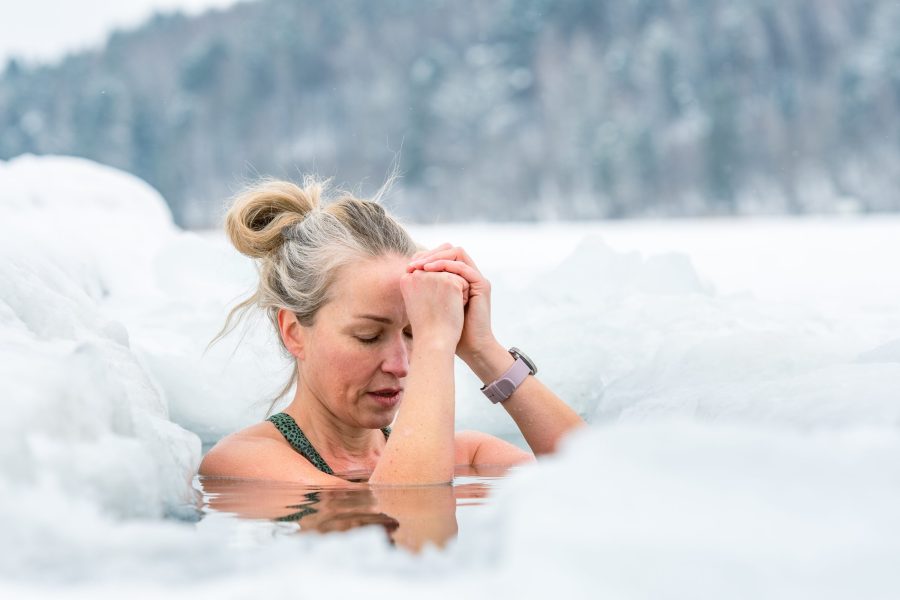
Cold showers, ice baths and plunges are all great for your mental health, but does cold exposure help burn fat too? Say goodbye to cosy nights in this season and leverage your winter shivers to boost fat loss
Words: Amy Dowrick | Images: Shutterstock
From ice bath plunges Wim-Hof-style to turning the shower cold before you hop out, there’s always been interest in cold therapy for improving stress tolerance and boosting mental resilience – but a recent study published by Nature has shown that it can also increase fat loss too.
“Shivering is one of the strongest stimuli that one can incorporate to stimulate fat loss,” says neuroscientist Andrew Huberman. “But most of the people that are using (and suggesting) cold as a means to increase metabolism fat loss are suggesting the exact wrong protocol.”
“There are two ways that shivering can increase fat loss, and there are several ways that you can use shivering and leverage the cold to accelerate fat loss – but you have to do it correctly.”
Does cold exposure help burn fat and lose weight?
“Cold exposure does several things,” says Andrew. “It doesn’t matter if it’s a cryochamber, an ice bath, a cold day and you forgot your sweater, or if you’re lying down in the snow. Cold causes the release of adrenaline from the adrenals, and it causes the release of epinephrine from these neurons that connect to fat.”
According to Andrew, the biggest effects of cold on metabolism and fat burning are through two routes:
1. Brown fat activation
Andrew says that you can trigger the activation of brown fat when you expose yourself to the cold – which will increase the amount of energy you burn by ramping up the intensity of the heat inside you.
“If you get into cold water or an ice bath and you try and remain calm and resist shivering, you actually short circuit this mechanism for increasing brown fat thermogenesis,” he says. “It’s the shivering itself that causes the brown fat to increase your burning, your burn rate and your metabolism.”
Andrew says that when you get into cold and you shiver, the shivering and low-level movement of the muscle triggers the release of a molecule called succinate.
2. Succinate release
“Succinate acts on the brown fat to increase brown fat thermogenesis and fat burning overall,” says Andrew. “It actually increases body heat, and over time it can also increase the amount of brown fat by converting beige fat into true brown fat.”
“If you resist the shiver, you are not going to get the increased metabolic effect because you are not going to get the succinate release,” he adds. “So, if you want to get your body heat and your thermogenic level to go up, you need to shiver.”

How to practice cold exposure training safely
How many times a week?
According to Andrew, how many times a week you need to expose yourself to cold will depend on how much fat you’re trying to lose, as well as how much you’re trying to increase your metabolism.
“There are studies that describe positive effects on fat loss when exposing yourself to cold anywhere between one and five times per week,” he says. “But it turns out that just one exposure per week can be valuable.”
How long?
Staying in the cold for longer and waiting to shiver doesn’t necessarily mean you’ll be burning more fat – and it’s potentially more dangerous.
“The goal is to get the shiver-induced release of succinate so that it can trigger the brown fat,” he says. “If you want to trigger the shiver, try getting into the cold, then get out and don’t dry off. Then get back into the cold and back out again. This will definitely stimulate more shivering than just getting into the cold, waiting until you shiver and then staying there shivering.”
How cold should it be?
It’s important to be wary of getting into water that’s extremely cold without proper adaptation, as it can shock your heart and possibly give you a heart attack – so you must proceed with caution.
“Just cold enough to be uncomfortable is a good place to start,” says Andrew. “For some of you, that’s going to be 60°. For some of you, that’s going to be high 30s. It depends on how cold adapted you are.”
People also vary in terms of how well they can tolerate the cold, so Andrew suggests finding a temperature that you can get into one to three times a week.
Weight loss lies exposed: Experts share the 3 biggest myths that are actually making you GAIN weight
Try this
If you’re stuck on where to begin, Andrew shares a quick protocol that you can follow:
- Find a temperature that induces shiver for you: That’s going to vary depending on your cold tolerance and how cold adapted you are.
- One to three, maybe five times a week: Get in until you start to shiver, then after a minute or so get out.
- Don’t dry off: Spend one to three minutes out, but don’t dry off.
- Get back in: Get back in for anywhere from one to three minutes but try and access the shiver point again.
- Repeat: Do three repetitions – so three times in and three times out – in total.
Remember that it’s the cooling and rewarming process of the body where shivers kick in – which is distinctly different than just trying to get into the cold and staying there for as long as possible.
Andrew Huberman, Ph.D., is a neuroscientist and tenured professor in the department of neurobiology, and behavioral sciences at Stanford School of Medicine. Find out more at www.hubermanlab.com.