
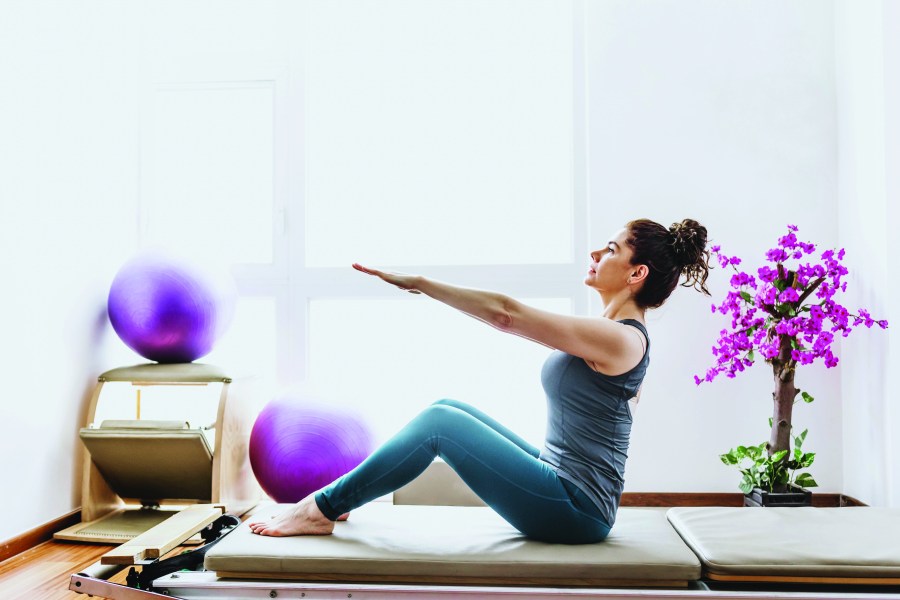
Pilates is hugely popular right now thanks to its ability to build strength, improve posture and increase flexibility – but might it have even more to offer during the menopausal years?
Words: Sarah Sellens | Images: Shutterstock
If there’s one thing to be said about the perimenopausal years, it’s that life gets busy and our bodies need looking after. Where we once could get away with working late into the night, we’re suddenly met by intense night sweats or brain fog the next morning. No longer can we ‘wing it’ with food, not unless we want to experience huge energy crashes and major sugar cravings. And, as for punishing workouts day after day, well, that’s a first-class ticket to feeling fatigued. At this time in our lives, smart exercise is arguably more important than ever – not only for the maintenance of muscle mass and joint mobility, but also for levelling our energy, focus and mood.
‘What traditionally works for women in their 20s, 30s and early 40s changes dramatically at the onset of perimenopause,’ explains Lesley Fitzpatrick, menopause specialist, wellness coach and founder of Align Studio in Worthing (alignworthing.co.uk). ‘The shift in hormones affects inflammation markers and how each system in the body responds to physical exertion – VO2 max changes, cardio output changes, inflammation rises and mobility within joints starts to change due to the fluctuation of hormones, specifically the quick drop in oestrogen and progesterone.’
This is why so many women report exercising in the same way they always have but seeing the body react differently after 40. ‘The body no longer responds to the same stresses that it responded to before,’ adds Lesley. ‘These stresses are now actually increasing cortisol in many women, and the results then are, for the large part, disappointing to most women at this stage.’
The Pilates fix
Something needs to shift, and science suggests that Pilates can help. ‘Pilates is brilliant in perimenopause. It builds deep core strength and supports your pelvic floor, which can weaken as oestrogen drops,’ says menopause fitness specialist and author of The Longevity Solution (£16.99, Yellow Kite), Kate Rowe-Ham. ‘It helps posture, balance and mobility, and the focus on breath is a lovely way to calm a nervous system.’
Indeed, a study published in the Journal of Exercise Rehabilitation reports that an eight-week Pilates programme followed by postmenopausal women resulted in improvements in menopausal symptoms such as hot flushes, as well as muscular strength (especially around the trunk), flexibility, balance and even psychological wellbeing.
‘I value Pilates in menopause because it helps women build strength, balance and confidence in movement at a time when their bodies may feel less predictable,’ adds Claire Mills, physiotherapist and founder of Core LDN (coreldn.com). ‘The controlled movements challenge the legs, hips, back and abdominal muscles, while giving us room to work on breathing and how the pelvic floor responds to effort. That matters if someone is noticing leakage, a feeling of heaviness or that they brace through every movement.’
But it comes down to more than concentration and control. With research suggesting that physical activity can decline during the menopausal years, discovering an activity you enjoy might be crucial as well. ‘The most important thing in menopause is moving – working on your wellbeing physically – as this will help any woman across her mental, emotional and physical landscape,’ says Lesley.
Strength without strain
Renowned Pilates instructor and former WF cover model, Korin Nolan, agrees that Pilates deserves a place in your perimenopause training routine. ‘As oestrogen levels fluctuate and decline during perimenopause, many women experience changes in joint comfort, bone density and muscle mass,’ she says. ‘Incorporating a well-rounded movement practice can make a profound difference to how the body feels and performs.’
Of course, high-impact exercise and strength training also deserve a place in your workout schedule, helping to maintain bone density and muscle mass at a time when both decline, but the low-impact nature of Pilates can be a boon as well. ‘What’s really important and often overlooked is that your body is well prepared before adding heavy loads in the form of weights or high impact in the form of jumps,’ adds Korin. ‘Pilates helps to create good foundational strength around the joints, ligaments and muscles, and encourages good movement patterns so that you are then able to do more taxing exercises with less risk of injury.’
And in case you’re wondering, low impact does not mean low intensity – a well-programmed Pilates session can be seriously challenging and, when incorporated side by side with any other form of training you do, will naturally improve your performance all round.
The mind benefits
Strength exists in the mind, too, and there’s emerging evidence that Pilates may also have a positive impact psychologically. One such study from this year, published in the International Urogynecology Journal, followed 40 postmenopausal women over a six-week period during which they practised online Pilates twice weekly, and found improvements in psychological menopausal symptoms, depressive symptoms and short-term feelings of anxiety.
‘We now know that women who exercise during the menopause experience fewer symptoms, and the symptoms they do experience are often dramatically lessened by exercise,’ agrees Lesley. ‘By consistently focusing on movement and exercise, you will improve mental clarity, focus, sleep, anxiety, depression and overall wellbeing. This isn’t nuanced – this is almost one of the most important decisions in your menopause journey.’
How Pilates fits in
Pilates isn’t the whole answer, of course. If there’s one thing all the experts consulted agree on, it’s that Pilates is just one part of the fitness puzzle, alongside progressive resistance training and cardiovascular exercise. Indeed, aerobic exercise is important for cardiovascular and metabolic health, while loading the muscles will help to preserve muscle mass and bone strength.
Interestingly, though, Pilates could be a good place to start. A recent Total Fitness white paper, Women & the Gym, reports that women’s gym membership falls below 30 per cent earlier in midlife than men’s. In fact, at ages 45 to 54, just 29 per cent of women are members. While the reasons are likely to be varied, from time pressures and caring responsibilities to energy and confidence, Total Fitness sees reformer Pilates as a potential route into strength-based exercise for women who may find a conventional gym environment intimidating – so much so that it has just launched a new women-only reformer Pilates studio at its Wilmslow club. ‘Our research suggests that reformer Pilates plays a significant role for women in strength training. As a more accessible and achievable route to strength than working out in a gym environment,’ explains Total Fitness CEO, Sophie Lawler.
So, where should you begin? ‘I would start with one or two Pilates sessions a week, building to two or three a week depending on time or the other forms of exercise that you do,’ recommends Claire. ‘I’d also recommend at least two days of progressive strength work covering the major muscle groups, plus regular brisk walking or another aerobic activity. The NHS target is 150 minutes of moderate activity a week, as well as strengthening activity on at least two days. Pilates can contribute to the strength goal when the exercises are challenging enough, but a gentle class should not be assumed to replace lifting progressively heavier loads.’
4 reasons to do Pilates in midlife
Pilates instructor Korin Nolan says Pilates will complement a rounded exercise schedule during midlife and beyond
- It keeps joints moving well: Changes in oestrogen can contribute to increased joint stiffness and altered connective tissue. Pilates takes the body through controlled ranges of movement, helping maintain mobility while building strength and control around the joint.
- It boosts your balance: Balance and proprioception become increasingly important as we age. Changes in muscle strength, reaction time, vision and sensory feedback can make it harder to react quickly when losing balance. Pilates incorporates unilateral work, coordination and controlled movement to help maintain stability, coordination, movement confidence and, ultimately, reduce fall risk.
- It creates a core connection: Pilates encourages coordination between the breath, deep abdominal muscles and the pelvic floor. This helps women develop greater awareness and control, particularly when experiencing changes such as urinary leakage or pelvic heaviness (though it should not replace assessment or treatment from a pelvic health physiotherapist for persistent symptoms).
- It gives you space to breathe: Deliberate breathing and concentration in Pilates help to release tension and create a sense of calm, which is especially valuable during periods of stress, poor sleep or emotional overwhelm, which for many women is prevalent at this stage of life.
Beyond the mat
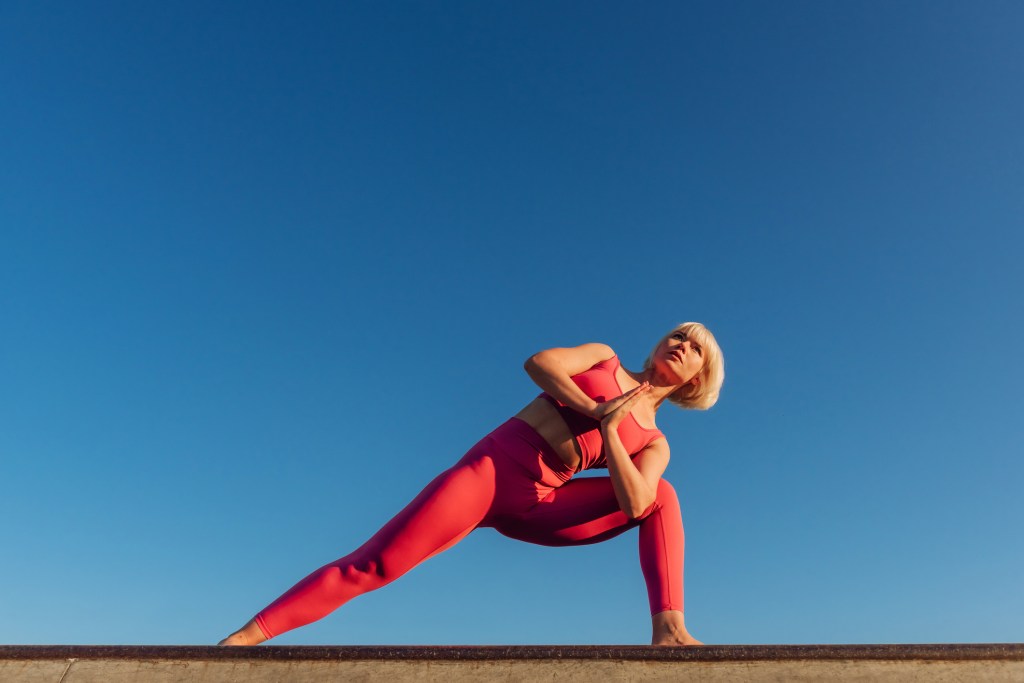
Build a more balanced routine by complementing your Pilates practice with other activities throughout the week. ‘Keep it simple,’ says YouTube fitness trainer Lucy Wyndham-Read. ‘You don’t need to buy equipment or spend money.’ Here’s what Lucy recommends.
Walk often
The number one exercise is walking. It’s an excellent low-impact and weight-bearing exercise for bone and muscle health. It’s safe on joints, boosts heart health and helps manage a healthy weight. With every step you take, walking creates a small amount of mechanical stress through your bones. This is known as the piezoelectric effect, which helps your bone cells sense that your bones are being used and loaded. This is one of the reasons regular weight-bearing activities such as walking are so important for helping maintain strong, healthy bones, making it the number one exercise for midlife and beyond.
Try this: Focus on a brisk walk, not an idle stroll, to maximise the benefits. Add in some intervals, such as one minute of walking at a brisk pace, then 30 seconds even faster, and simply keep repeating this sequence.
Stay strong
On top of walking, do three simple bodyweight exercises: press-ups, basic squats, reverse lunges. These collectively target all your major muscle groups and look after muscle, bone and joint health at the same time. The moves use body weight, which is safe on your joints, still considered weight and very effective.
Try this: Aim to do each move (press-ups, squats, reverse lunges) for one minute. Perform as many as you can with good form, and repeat 3 times. Do this 3-4 times a week. As you become stronger, simply do more in the time and then add in another set.
5 Pilates moves to master in menopause
Claire Mills, physiotherapist and founder of Core LDN, suggests five Pilates moves that could support the perimenopause.
Technique point: ‘Cue these moves with a lift of your pelvic floor as you exhale through the demanding part, then inhale to relax. The aim is to notice how the pelvic floor responds to movement, then allow it to relax again,’ says Claire. ‘These exercises challenge the pelvic floor in different ways, as well as looking at controlling pressure management, but they do not replace individual pelvic floor muscle training when someone has leakage or prolapse symptoms.’
T-balance
Stand on one leg with a soft knee. Hinge at the hip, letting your other leg reach behind you and your torso tip forward until it forms a long line or a smaller version of a ‘T’. Breathe out as you return to standing. Do 8-12 repetitions each side, with a hand on the wall if needed. I use this to challenge balance without asking someone to brace or grip through her pelvis.
Bridge series
Lie on your back with knees bent and feet hip-width apart. Breathe out as your hips rise and inhale as they lower, checking that you can fully relax your pelvic floor between repetitions. For a rolling bridge, move through the spine gently rather than lifting it in one go. Progress to alternating marches only when you can keep your pelvis level and breathe easily: hold your hips up and lift one foot just off the floor, replace it, then lift the other, doing 4-6 marches per side. It strengthens the glutes and challenges pelvic stability. The changing load from one leg to the other is the pelvic floor challenge.
Ball squeeze with overhead arm reach
Lie on your back with knees bent and a soft Pilates ball between your thighs (pictured). Hold your arms at your sides. Gently squeeze the ball and soften your ribs: think light pressure, not maximum effort. As you breathe out, reach both arms overhead. Inhale as the arms return to your sides and the squeeze releases. Do 8-12 repetitions. Keep your ribs soft and connected, and move with your breath. This can be progressed by holding small hand weights, or can be done in a double table top position for an increased abdominal challenge and pressure control of the pelvic floor.
Four-point knee hover
Start on all fours with hands under shoulders and knees under hips. Breathe out and lift both knees just a centimetre or two from the floor. Hold for a breath, lower and relax, repeating 6-8 times. This asks the abdominal muscles and pelvic floor to manage a short burst of effort without breath-holding.
Side-plank clam
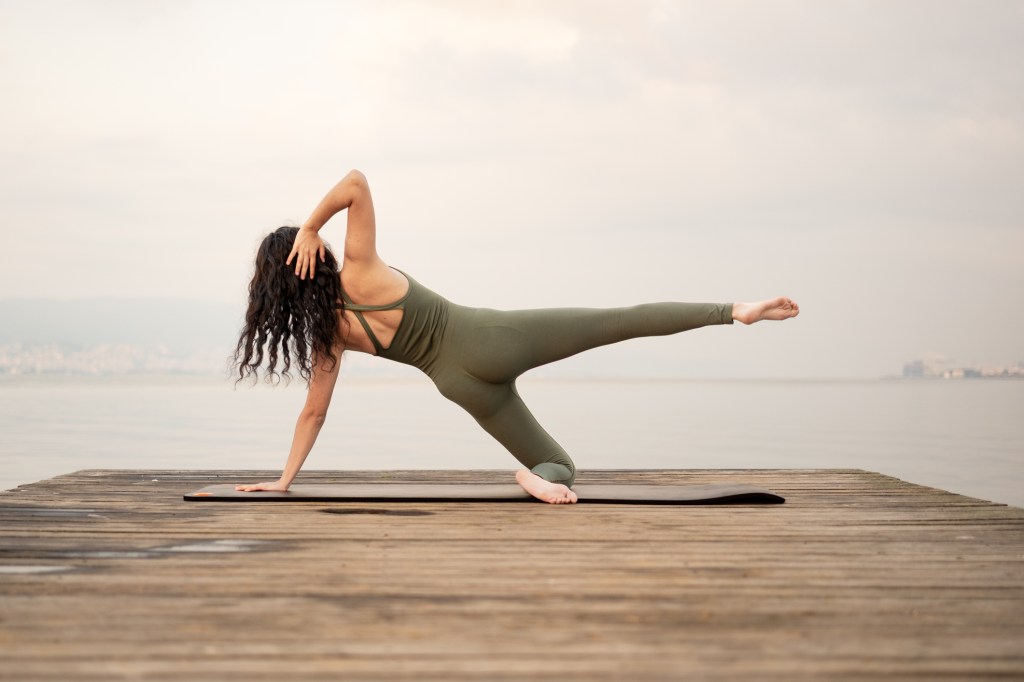
Set up a half side plank on your forearm (pictured), then lower on to bent knees with feet together. Breathe out as you lift your hips and open the top knee a small distance; inhale as you close the knee and lower your hips. Do 6-8 repetitions on each side. This exercise works the shoulder, trunk and outer hip.