
Exercise expert Sean Murphy reveals the science behind shaping your shoulders with the correct upper body workout technique
Words Sean Murphy | Images: Shutterstock
The shape people describe as ‘sculpted shoulders’ comes from one thing: the middle head of your deltoid getting bigger. There’s no separate process for definition or tone. The muscle is either there or it isn’t, and how much of it you can see depends on how lean you are.
That matters because most of the advice aimed at women points in the wrong direction. High reps, light weights, lots of variations. It sounds sensible but it produces almost no results because the muscle is never challenged hard enough to have a reason to grow.
Your shoulder is three separate muscles doing three different jobs and they don’t all need the same level of attention. Once you know which one you need to train directly and how to load it, the rest is simple.
The head most miss
The head you need to train is the one most people miss. The deltoid has a front, middle and rear head. The front head flexes the arm forward, and it already gets plenty of work from every press and push exercise you do. The rear head sits at the back, contributes to how you look from the side and how you hold yourself, and picks up a good amount of stimulus from rows and pull-downs.
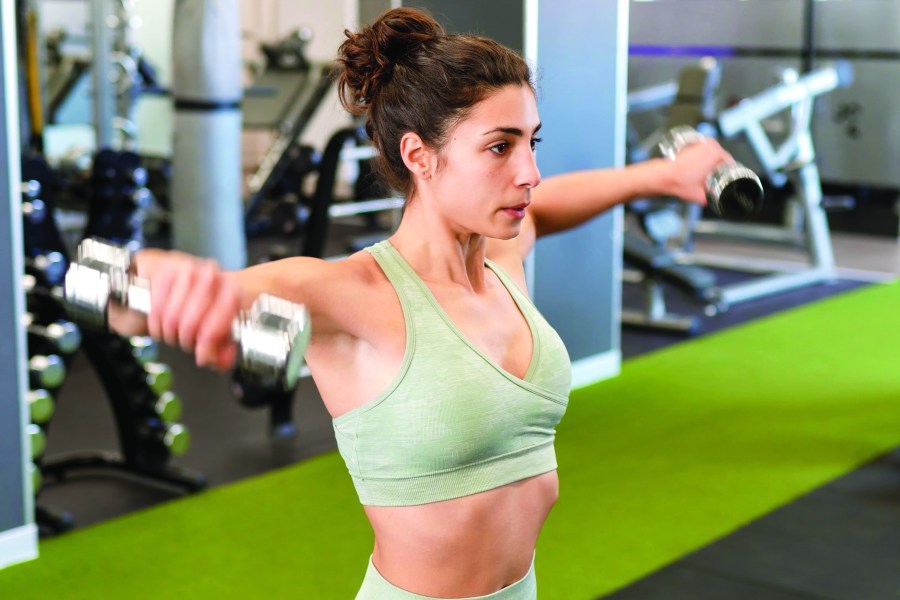
The middle head is the one I point out most often. Its job is lifting your arm to the side and almost nothing else trains it. If your shoulders aren’t changing shape despite training hard, this is nearly always why: the muscle that creates the shape isn’t being trained directly.
The solution is simple. Keep pressing because it builds the front head and it’s a good movement to get strong at. Keep rowing and pulling because that covers the rear. Add lateral raises because it’s the only way the middle head gets loaded.
One thing worth being honest about, though. How visible any of this becomes depends on how much body fat you have, as well as muscle. You can build a well-developed middle deltoid and still not see much of it if there’s a layer of fat sitting on top.

How you train matters
In my experience, the reason lateral raises don’t work for most people is simply that the resistance is too light. Fifteen or 20 reps with something you could keep going with forever gives the muscle no reason to change. Every set should finish within a couple of reps of the point where you can’t do another one with clean form. If you’re stopping because you’ve hit a number rather than because the muscle has had enough, not much is going to happen.
The second thing is where in the movement the load actually sits. With a dumbbell, the exercise is hardest at the very top of the move, where the muscle is shortest and weakest, but there’s almost no resistance at the bottom. That bottom position, where the muscle is lengthened, is where a lot of the growth stimulus comes from, and a dumbbell simply doesn’t load it.
A cable does. Set the pulley about one notch below hand height, so the cable runs roughly level with your hand at the start, and the tension is on from the very first inch of the movement. It also lets you add weight in smaller increments than dumbbells typically allow. This matters to an exercise like this because going from one pair of dumbbells to the next can be a huge jump in relative terms, and lead to poor execution, stalled progress or injury.
If dumbbells are what you’ve got, whilst not optimal, they still work. Lean forward around 10-to-15 degrees and start with your arms slightly across your body instead of hanging straight down, then you’ll get more resistance into the lower half of the range. On execution: it’s your upper arm that moves, and past about 30 degrees your shoulder blade will start moving too, which is normal. Take your arms slightly forward as they rise rather than straight out to the sides, so they’re travelling in line with where your shoulder blades sit. Don’t rotate your hand inward and don’t tip it over at the top like you’re pouring from a cup. If you’re struggling to feel it working, try one arm at a time. Most people find that far easier for learning where the effort should be.
Sets, reps and progress
Eight-to-15 reps works well. It’s heavy enough to challenge the muscle properly and light enough that you can control the movement, and that matters on a small muscle where technique falls apart quickly.
If the middle head hasn’t been trained directly before, start conservatively – four sets per week, which could be split over two sessions of two sets each per workout. That is enough volume to start producing change, and it’s roughly where we’d start a client who’s never done this work before. Build from there based on how you’re recovering and how your body is responding. You could increase the number of sets you do per week over time: one-to-two sets per month, all the way up to 10+ sets per week if this really is a focus point of yours.
Progression is where most people either get it wrong or overthink it. Adding reps and adding weight produce much the same result, which is useful because adding reps is far more practical for a small lift. Work at the bottom of your rep range, then add a rep or two each week until you’re at the top of it across all sets with good form. Next, put the weight up by the smallest amount available and start with lower reps again.
Give it three-to-four months of consistent work before you judge whether or not it’s working. Muscle doesn’t change quickly, and it changes more slowly still on a small muscle group that’s never been trained directly. But load the middle head properly, take your sets close to failure, add a little each week, and it will come.
Sean Murphy is global chief personal training officer at Ultimate Performance (U.P.), with more than 15 years’ experience as a leading authority in the fitness industry. He oversees more than 300 trainers worldwide and sets the standards that have made U.P. the global benchmark in strength training since 2009. A senior member of the Executive Team, Sean leads the development and execution of the U.P. Method, with responsibility for trainer education, exercise execution, gym-floor performance and clients’ results. Visit ultimateperformance.com