

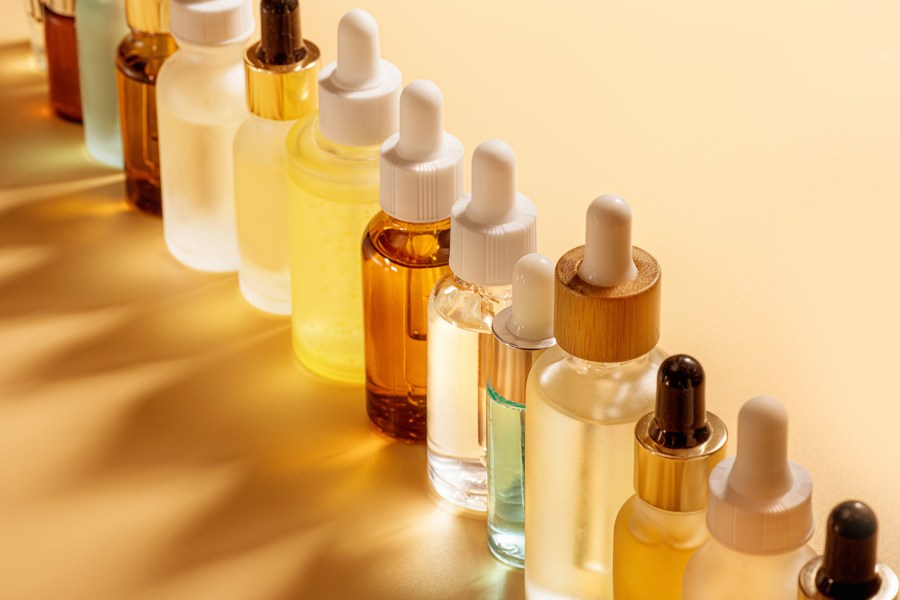
From retinol and vitamin D to hyaluronic acid and ceramides, there is no shortage of skincare ingredients promising to deliver impressive results. However, it is peptides that is currently the wellness world’s new obsession – but what is driving the buzzword on everyone’s lips? We take a look at the peptide boom that is dominating the headlines and social media feeds.
Pics: Getty images
The buzz around peptides has been growing in momentum and whilst the skincare ingredient has been around for years, suddenly everyone wants in. Although the hype is partly driven by beauty marketing and celebrity endorsements, there are other factors that have come into play; including the fact that more people have become familiar with the word due to the emergence of GLP-1 drugs like Ozempic which is a peptide-based medication. And then there is the consumer mind-set which has seen a shift from people wanting quick and instant results to more products that fit into the “longevity” trend and peptides sit well there as they help skin preserve function and regenerate.
As a beauty editor for over 25 years, I’ve seen skincare ingredients come and go – many ride the hype and die down – but I’m convinced peptides are here to stay. However, it is a complicated market to navigate with so many brands suddenly delivering peptide-based products so to break it down, it’s important to understand what peptides actually do and how you can benefit from them. Below, I ask the experts for their advice on peptides.
WHAT ARE PEPTIDES?
“In a nutshell, peptides are short chains of amino acids, the building blocks our skin needs to produce important proteins such as collagen and elastin,” explained aesthetician Elena Cudworth, founder of Elinique Aesthetics.
“Certain peptides also act as messengers within the skin, sending signals that can help support processes such as skin repair, firmness and overall skin health.
“Peptides can be incorporated into your everyday home skincare routine, but they can also be used in professional treatments such as microneedling, HydraFacials and other advanced skin treatments to support skin rejuvenation and improve overall skin quality.”
WHERE YOU’LL FIND PEPTIDES
Peptides are now in a huge range of beauty products, including face serums, moisturisers, lip and eye creams, haircare and body care too. Whilst many are aimed at the women’s market, peptides are well-established in men’s skincare too.
HOW LONG HAVE PEPTIDES BEEN AROUND FOR?
Peptides are not a new thing, in fact they’ve been studied and used in medicine and skincare for decades. According to New York plastic surgeon Masoud Saman: “They were first discovered in 1901 and initially thought of as “cellular waste.” Overtime we have learned that they are indeed cellular communication packets. Commands, sent from one cell to another to act a certain way: produce collagen, release hormone, regulate blood sugar. In other words, the term “peptide” does not tell us what the command within it is as different peptides have different functions, and the evidence behind them varies. The word alone doesn’t tell you what a cream will do.”
As someone who has used peptides in his clinic since 2015, Dr Saman is very familiar with the ingredient. “I’ve used peptides for non-surgical hair restoration, post-laser and microneedling skin treatments, and for improved skin recovery after rhinoplasty and facelift surgery. Peptides aren’t new but they are now in the mainstream for good reason.”
WHY THE BUZZ AROUND PEPTIDES NOW?
As mentioned above, social media has been a huge force behind the peptide boom, as well as celebrities shouting about its benefits. And with the rise of people taking GLP-1 drugs, that are peptide-based medicines, the word has entered the mainstream conversation. And this has helped more people become aware of the ingredient and what benefits peptides can play.
“They have actually been used in skincare for quite a while and are now found across many different skincare brands, but I think people are becoming much more aware of them and starting to understand their benefits,” explained Elena Cudworth.
“I think they’ve become much more talked about because people are increasingly educated about skincare ingredients and are looking for effective ways to support healthy ageing. Formulations have also become more advanced, so we now see different types of peptides being used to target different skin concerns.”
There are plenty of other reasons why peptides have become a buzzword, as aesthetician Alice Henshaw, founder of Harley Street Injectables and SkinCycles, points out: “The excitement around peptides is because they’re one of the few ingredients that give you a visible result without irritation, so they suit the skin that can’t tolerate retinol, which is a lot of skin.
“And then there is the fact that Korea made them affordable and mainstream, and the research on signal peptides caught up, so there’s now proper evidence for collagen stimulation. Add a generation of women who’ve been burned by too many acids and want results without the sting, and you have a boom.”
PEPTIDES AND MENOPAUSAL SKIN
Can they help with menopausal skin?
“Yes, and it’s where I use them most,” explained Alice Henshaw. “Menopausal skin loses collagen fast, up to 30% in the first five years, and gets thinner and drier, and it’s often too reactive for strong retinoids. Peptides give you the collagen signal without the irritation, and paired with a good ceramide moisturiser and SPF they’re the backbone of how I treat perimenopausal patients between appointments.”
In agreement is Deirdre Walters, one of the founding partners of Untapped Innovation – a global agency helping R&D teams at companies like P&G, Unilever, and Reckitt create breakthrough products and compelling product stories – who believes there is a strong link between peptides and the longevity and menopause connection.
“The peptide category is benefiting from a wider “skin longevity” movement, where consumers are increasingly focused on maintaining optimal skin function for longer rather than attempting to aggressively “reverse” signs of age”, she explained.
“This conversation is particularly relevant within the perimenopause and menopause space. As oestrogen levels decline, the skin experiences accelerated collagen loss alongside increased dryness, barrier fragility, and slower recovery processes. Peptide technologies are increasingly being explored within formulations designed to support skin resilience, hydration, and structural integrity particularly during hormonal transitions.”
PREDICTIONS FOR THE FUTURE OF PEPTIDES
“Looking ahead, we are likely to see continued exploration of increasingly targeted peptide technologies, alongside more personalised approaches to skincare,” explained Deirdre Walters. “This may include formulations inspired by individual skin conditions, microbiome research, and advances in diagnostic-led beauty. We are also likely to see further growth in “inside-out” beauty concepts, where topical skincare is positioned alongside ingestible supplements as part of a broader conversation around holistic skin health and longevity.
“Ultimately, peptides are evolving from “buzzwords” into longer-term skincare support, because they align closely with the most important benefits consumers are seeking and where the industry and skincare sector is moving: supporting skin function, resilience, and long-term skin health.”
And then there is the growing rate of copper peptides which seem to be gaining huge momentum. In fact copper peptides on Google search interest has apparently increased by 300 percent in the UK over the past year. While copper peptides may be the future of peptides, some beauty brands like Wildsmith Skin has been championing their benefits since 2018.
WHAT MAKES COPPER PEPTIDES DIFFERENT?
While many peptides primarily act as messengers, signalling processes within the skin, copper peptides have a dual role. They bind to copper ions and help transport them into the skin, where copper plays an important role in processes associated with repair, regeneration and enzymatic activity.
“This means copper peptides are about more than targeting a single skin concern. Instead, they take a more holistic approach, supporting the skin’s natural repair processes and helping to promote barrier strength and resilience over time,” explained Wildsmith CEO Katherine Pye.
“At a time when consumers are looking beyond quick fixes and towards ingredients that support long-term skin health, products like Wildsmith’s Active Repair Copper Peptide Serum and Cream offer a timely alternative to more aggressive anti-ageing approaches.”
PEPTIDE WARNINGS: TAKE NOTE
Whilst in the main, peptides are not dangerous, there are some things to be aware of.
“The peptides used in well-formulated skincare are completely different from the unlicensed injectable peptides currently being promoted online. Just because something is called a peptide does not automatically make it effective or safe,” warned aesthetician Dr Tom Kamal, of the Dr Tom clinic.
“And that stands with skincare too; the particular peptide used, the quality and stability of the overall formulation are what really matter.
“Peptides used in properly formulated skincare are generally considered safe and well tolerated. But for me the main drawback is that the evidence is stronger for some peptides than others, and managing patient expectations is key, because the results tend to be gradual rather than dramatic and instant.”
He adds: “Skincare can be an absolute minefield so product choice can be difficult to navigate and trying to distinguish between marketing and genuine research and evidence is not easy. This is even more relevant with peptides because they can be challenging to formulate as they need to remain stable and reach the right area of the skin. So two products displaying the word “peptide” on the label may perform very differently. With the wrong product choice patients can very easily become ‘underwhelmed’
“And because of this my favourite product I recommend is AlumierMD’s EverActive C&E + Peptide. It combines peptides with staple key ingredients vitamins C and E in a really considered formulation, using ingredients and a proper formulation that’s supported by data and evidence, rather than simply following the latest skincare trend because it’s currently popular.”
Also warning of unlicensed products is Dr Riaz Agha, consultant plastic and reconstructive surgeon at Harley Clinic Group.
“I would draw a very firm line between cosmetic peptide skincare and the unregulated injectable ‘peptides’ being promoted online for anti-ageing, muscle growth, fat loss or supposed longevity benefits. These are completely different propositions. Some injectable peptide products have limited human safety data, and regulators have specifically raised concerns around certain compounded injectable peptides,” he explained.