


From gentle yoga and warm baths to dimming the lights and changing your phone display, these simple evening rituals can help your body and mind transition from busy day to restful night
Pics: Getty Images
Even when your body finally hits the sofa, your mind can still be running at full speed. But what if your evening could become more than just the bit between work and bedtime? A chance to press pause, soothe your senses and signal to your body that the day is done.
From calming rituals and cosy surroundings to nourishing food and screen-free moments, creating your perfect evening wind-down could be the simplest – and most pleasurable – way to relax both body and mind.
Step forward evening-maxxing, your new night time routine set to sort your nervous system out fast.
It’s time to relearn winding down
Nurse and midwife, Lizzy Bernthal, agrees that techniques need put in place with purpose because we ‘can’t expect our brains to be going at 100 miles an hour and then suddenly switch off because our head hits the pillow.’
And she’s right, our brain and body need time to wind down.
‘During the day, when we’re busy, problem-solving and making decisions, we tend to have more faster beta brain-wave activity. As we relax, more alpha activity appears, with theta becoming more prominent as we get drowsy.
‘Light is important too. As it gets darker, our brain produces more melatonin, helping signal that it’s time to sleep. Bright light late in the evening can delay that signal.’
Continuing to work, scroll and solve problems right up to bedtime as our cortisol naturally begins to fall can push us into an alert state for longer.
Make the magic happen
• Give yourself at least 20 – 30 minutes to wind down
• Dim the lights and reduce screen stimulation
• Step away from work and emails
• Write down anything still whizzing around our head
• Use slow breathing to help calm your nervous system
• Have a warm shower or bath and keep the bedroom cooler
• Avoid caffeine later in the day and be mindful of alcohol close to bedtime
Donna Noble, a yoga teacher and wellbeing educator, is a big believer in movement and although anything too vigorous is a no-go, she believes it can be used correctly as a way to wind down.
Gentle yoga
‘A few gentle yoga movements, in bed, can be a lovely way to transition towards sleep and there’s research behind it. A systematic review of 19 studies involving 1,832 participants found that yoga was associated with a significant improvement in sleep among women with sleep problems.
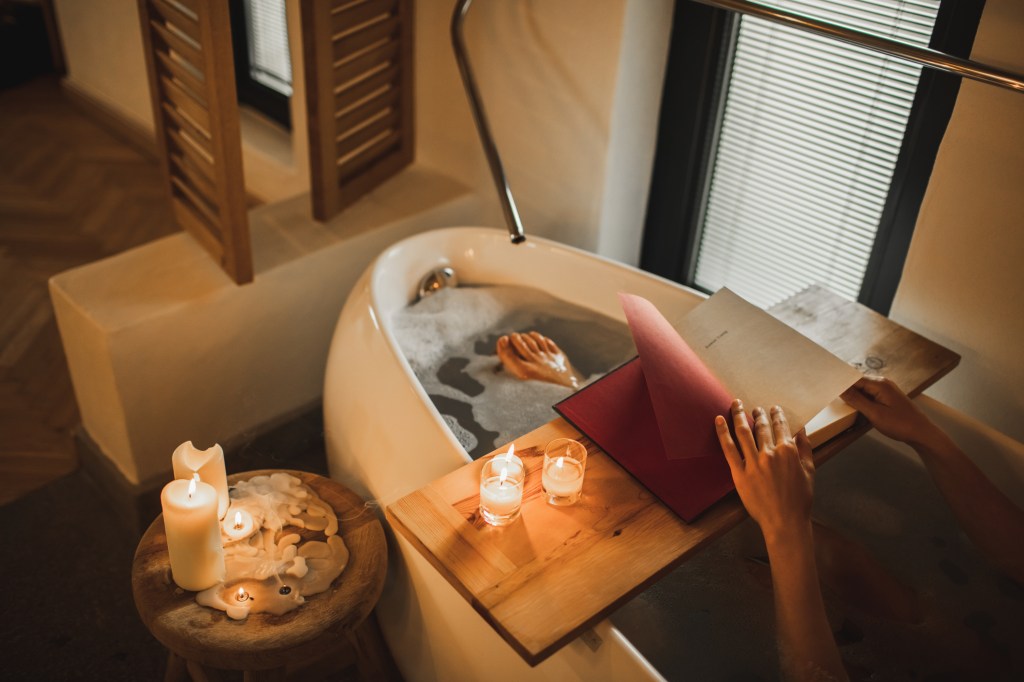
Have a warm bath before bed
‘There’s some really interesting science behind the humble bath. A review found that bathing or showering in water around 40 – 42.5°C, 1 – 2 hours before bed, was associated with improved sleep quality and sleep efficiency and helped people fall asleep faster. Even as little as 10 minutes was associated with a benefit.
‘It works in part because warming the skin increases blood flow to the hands and feet, helping the body release heat and allowing core body temperature to fall, which is part of our natural preparation for sleep.’
Change the colour of your phone screen in the evening
‘This is one people might not think about. Research comparing different wavelengths of light found that shorter wavelengths, including blue and blue-green light, produced much greater melatonin suppression than red light at 660 nm.
‘So if I’m going to use my phone in the evening, changing the display towards the red end of the spectrum is one way of reducing exposure to the wavelengths that have the strongest effect on melatonin. It doesn’t mean red light sends you to sleep, but it is less disruptive for our sleep biology.’
Donna especially loves that no-one has to rush out to buy the latest expensive gadget in order to aid your evening health.
‘You don’t need the latest sleep gadget. There are small ways of working with the body rather than expecting it to go from being switched on all day to asleep the minute our head hits the pillow.
‘For me, that’s really what an evening routine is about. Giving the body the cues and conditions it needs to do what it already knows how to do.’