
On its own, yoga provides a wealth of benefits for your health, fitness and wellbeing. But by adding weights to your poses and sequences, you can seriously boost your strength gains – and for midlife women, the benefits could also extend to reversing age-related muscle loss and improving bone density.
As you age, your muscle mass and bone density naturally begin to decline. Because of this, upping your strength training in midlife is vital to maintain strength, protect your joints and prevent injuries.
‘Pretty much every midlife woman now knows that strength training is important as we get older,’ comments Lesley Muir, an experienced yoga therapist, founder of Be Happy Yoga and creator of weighted yoga programme, Yoga Strong®. ‘We’ve all read about the risks of osteoporosis, osteopenia, sarcopenia (age-related loss of muscle mass) and the importance of resistance training for healthy ageing. We know we need to challenge our muscles and bones.’
‘But for millions of women who already have a regular yoga practice,’ she adds, ‘the choice often feels like this: either carry on doing the yoga you love, or spend that time lifting weights in the gym. Many yogis don’t enjoy gym environments and most women don’t have endless time to fit both into their lives.’
That’s where weighted yoga comes in.
What is weighted yoga?
On its own, yoga can provide full-body strength benefits, with research showing it can even potentially reverse age-related bone loss – without the need for weights. But if you’ve been practicing yoga for some time, and you feel like your muscles could do with an extra challenge, weighted yoga could be the perfect strength training option for you.
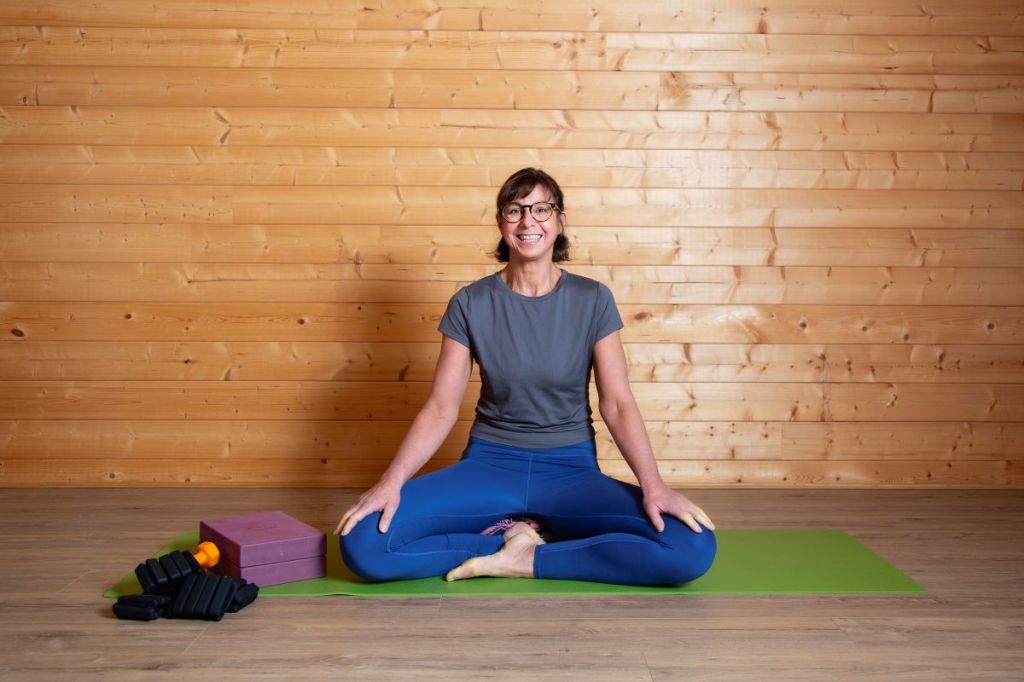
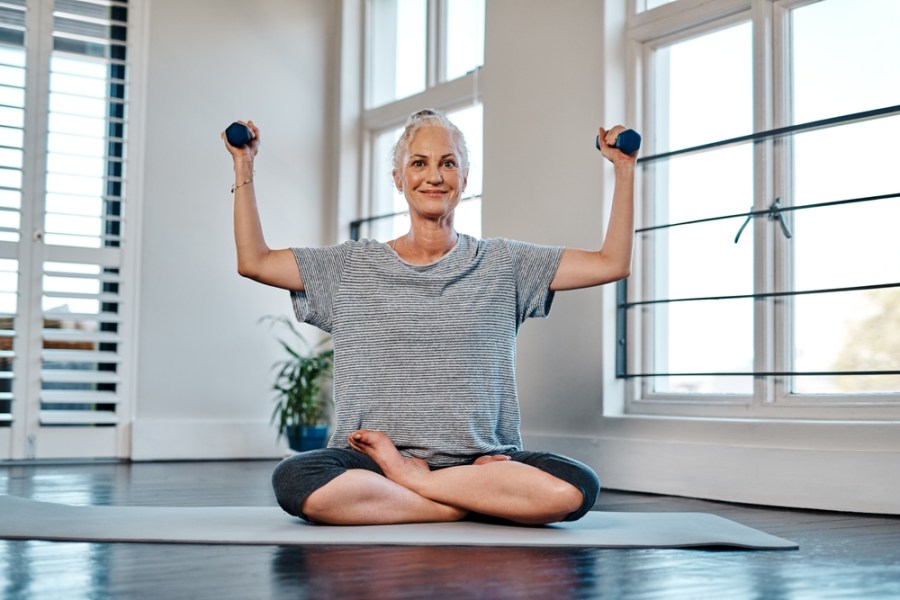
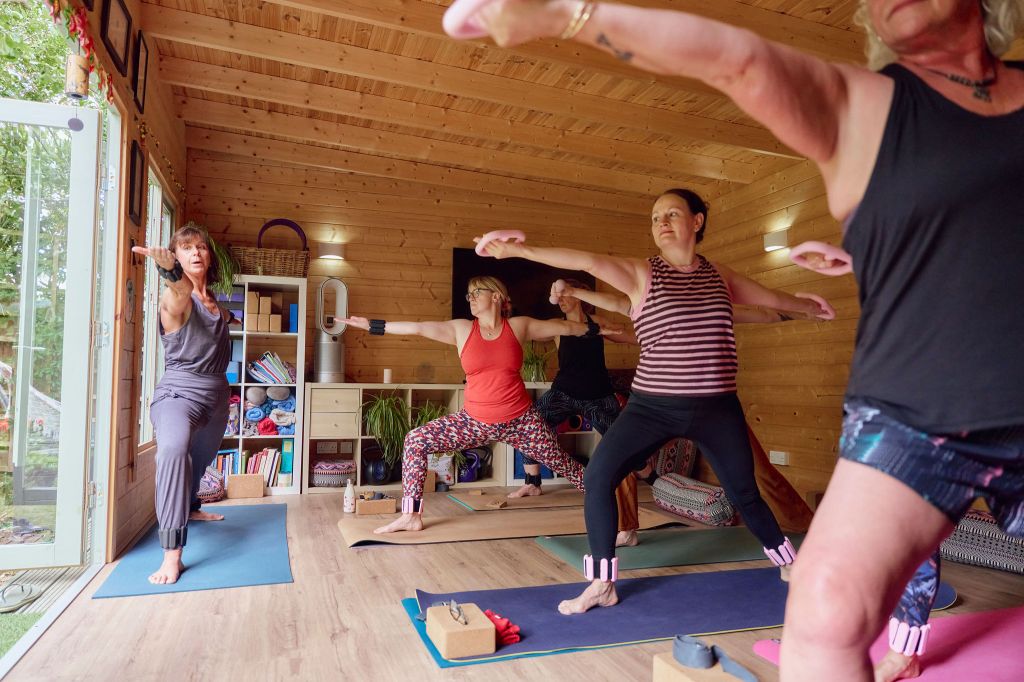
Weighted yoga combines yoga with strength training by adding dumbbells and wearable weights to classic postures and poses. By adding extra resistance to each pose, your body has to work harder to maintain control – leading to greater gains for your muscle strength, joint stability and bone density.
‘As I reached my mid-fifties, I noticed my muscle tone and strength reducing,’ Lesley tells us. ‘Despite teaching yoga full-time, swimming regularly and walking most days, my upper body strength was declining and I tired more easily. Instead of replacing yoga with strength training, which I tried but didn’t really enjoy, I decided to combine the two and see what happened.’
‘I started experimenting with light dumbbells and wearable weights, adapting familiar yoga poses,’ she adds. ‘Even with the 1–2 kg weights I started out with, it was more challenging than I expected, but the results were brilliant. I quickly noticed improvements in my strength, stamina and energy, while still enjoying everything I love about yoga.’
Why weighted yoga works
‘For me, one of the biggest misconceptions is that strength training only counts if you’re lifting the heaviest weights in the gym,’ says Lesley. ‘Research has shown that lighter weights can also be highly effective for building muscle when exercises are performed regularly with good technique and sufficient effort.’
When it comes to weighted yoga, it’s not about lifting heavy weights or doing endless reps – it’s simply about upping the resistance of traditional yoga poses, which already offer strength-boosting benefits on their own. ‘Holding a Warrior II pose for several breaths in a regular yoga class is already demanding,’ says Lesley. ‘But if you add 1–3 kg dumbbells, the muscles have to work significantly harder to maintain control, balance and good alignment.’
Another benefit to weighted yoga – particularly for people who have loved and practised yoga for years – is that it allows you to meet your strength training goals in midlife without completely overhauling your fitness regime. ‘You shouldn’t have to choose between the yoga you love and the strength training your body needs,’ comments Lesley. ‘Practising yoga with weights enhances a practice that millions of women already love and makes it even more beneficial as you age.’
‘Ultimately, it’s not about turning yoga into a gym workout,’ she adds, ‘it’s about meeting women where they are today and helping them become stronger – while at the same time, enabling them to enjoy what brought them to yoga in the first place.’
Real-life results from midlife women
While experimenting with different weighted yoga poses, and developing her Ashtanga-inspired Yoga Strong® programme, Lesley tracked her progress by monitoring her body composition measurements – and the results speak for themselves. ‘Over six months, I lost 4.5 kg,’ she reveals, ‘but at the same time, I reduced my body fat and increased my skeletal muscle percentages.’
‘This was without following a restrictive diet or using any supplements,’ she adds. ‘I was just eating a balanced, whole-food, high-protein diet with lots of fresh vegetables and I continued using my weights during yoga. I have since tracked the same with clients and they see similar outcomes.’
‘The feedback from the women who practise weighted yoga with me has been incredibly consistent,’ Lesley tells us. ‘They tell me they have more energy, feel stronger carrying shopping, lifting grandchildren and tackling household jobs that once felt difficult.’
‘They are also becoming leaner, losing body fat and reducing their waist circumferences by an average of 4 cm, which is a really important long-term health indicator,’ she adds. ‘Many are also surprised that as their muscles become stronger, they also become more flexible.’
3 weighted yoga poses to try
Give the following poses a go to get started with weighted yoga at home. ‘Start with light weights to ensure you can comfortably move with control,’ Lesley recommends. ‘You will need to adapt the poses where necessary to protect your joints and there are many arm variations and holds you can incorporate to add interest and improve their effectiveness.’
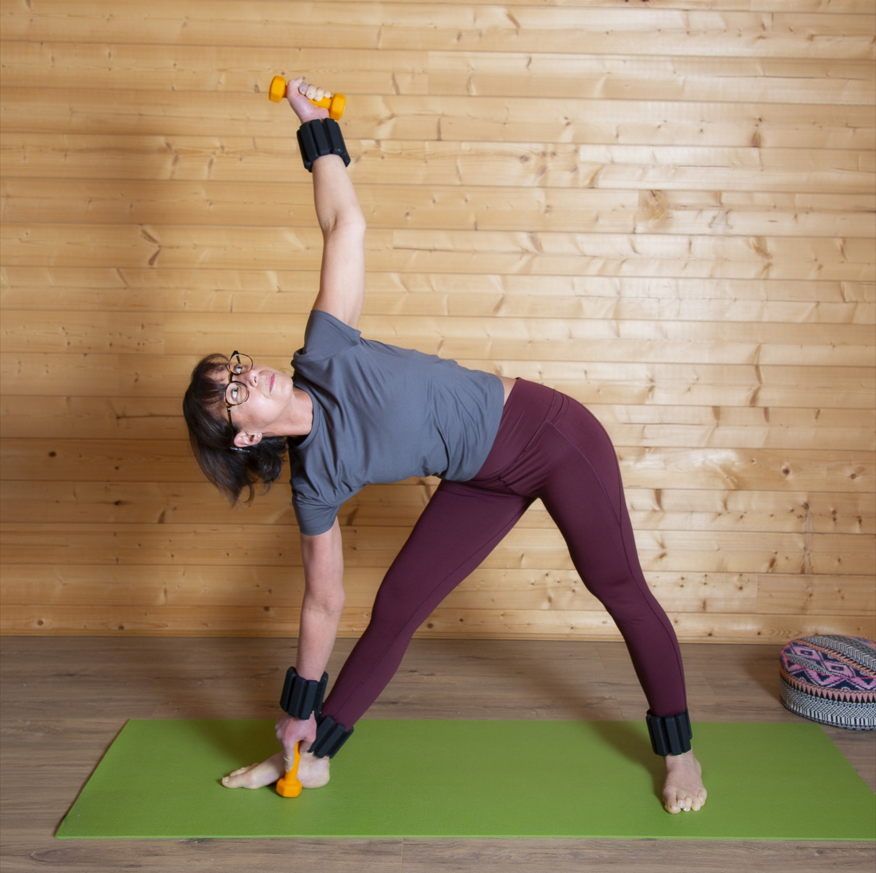
Triangle Pose
- Hold a light weight (1-3kg) in each hand. You could use dumbbells or water bottles. For an extra challenge, add wearable weights to your ankles and wrists.
- From the top of your mat, step one foot back, turning the foot out to a 90-degree angle and opening your hips and torso to face the side.
- Keeping both legs straight, begin reaching your front hand forward then tilt down from the waist, reaching the hand down towards the floor. You can use a block here to bring the floor closer.
- Hold here for a few deep breaths, using your core muscles to keep yourself strong and stable. If it feels comfortable for your neck, and doesn’t make you dizzy, try turning your gaze up towards the top hand.
- Return to standing with control, then repeat on the other side.
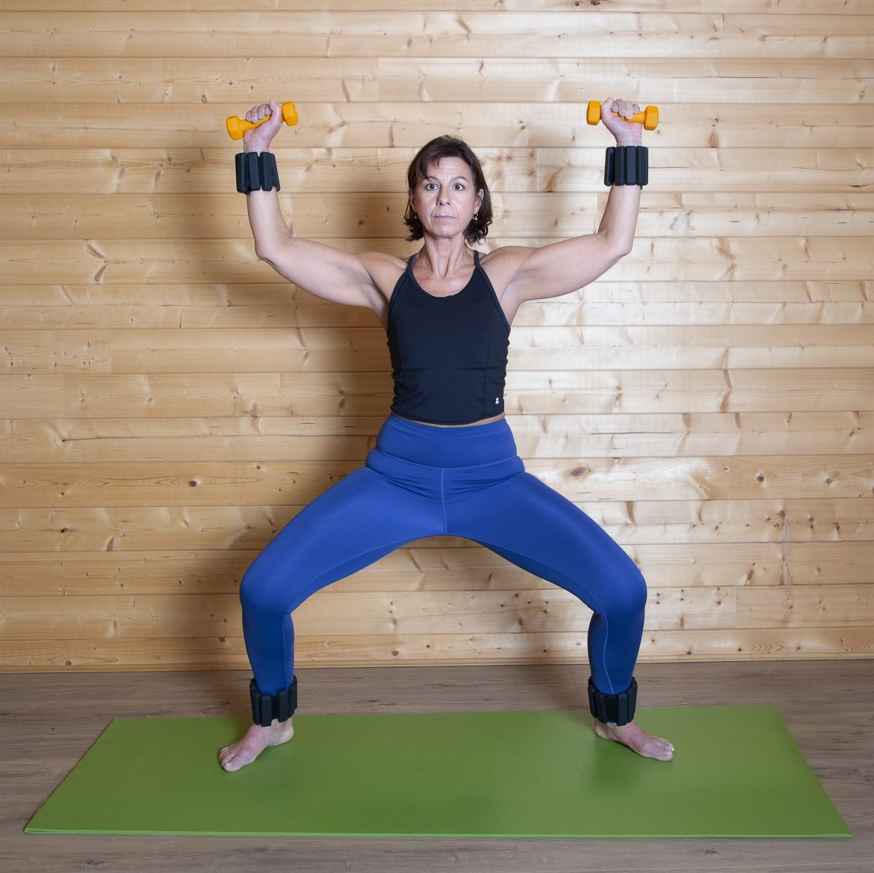
Goddess Pose
- Hold a dumbbell or water bottle in each hand. You can also attach wearable weights to your ankles and wrists.
- Widen your stance and turn your feet out. Bend both knees, keeping the knees in line with your feet. If your knees move past your ankles, try widening your stance a little more.
- Take a deep breath, then raise both arms, elbows bent and forearms pointing up. Engage the muscles in your arms, shoulders and back.
- Hold here, breathing deeply and feeling your muscles working hard to support the additional weight.
- Slowly lower your arms and return to standing.
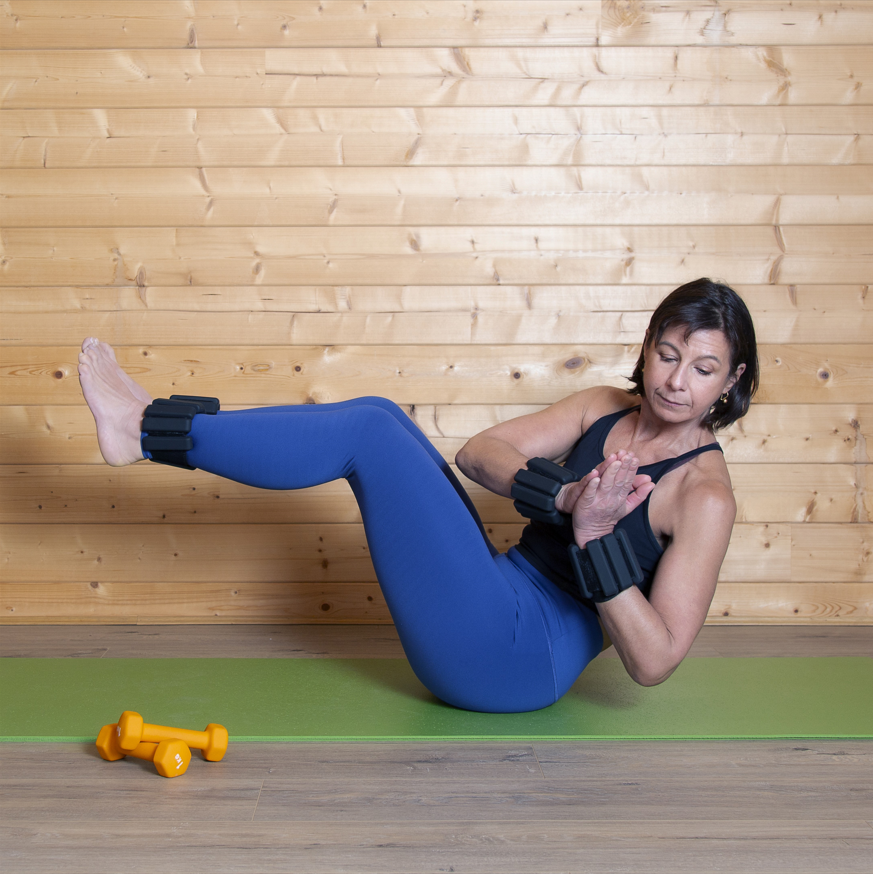
Boat Pose
- Sit on your mat with knees bent and feet grounded. Attach a wearable weight to each ankle and each wrist. You could also hold a dumbbell or water bottle in both hands.
- Maintaining a long spine, begin slowly leaning back until you feel your core muscles engage. Gradually begin to lift your feet off the ground – you can try lifting one at a time or both.
- Hold here for a few deep breaths. You can either keep your knees bent, or try fully extending your legs in front of you.
- For an extra challenge, try slowly twisting from one side to the other.
- Slowly return to seated with control.
About Yoga Strong
Lesley’s full Yoga Strong® programme is available to join in-person at her Kingston yoga studio and online. The programme restarts in early September and includes classes, online videos and nutritional coaching. Find out more at behappyyoga.fit.