
From sauna sessions to ice baths, contrast therapy is becoming a popular recovery ritual for women looking to soothe sore muscles, support their training and carve out time to switch off.
Images: TEMZ Words: Amy Wilson Hardy
If your idea of post-workout recovery is collapsing on the sofa and hoping your muscles eventually stop aching, there could be another option worth knowing about.
Contrast therapy – the practice of alternating between heat and cold – is gaining attention as a recovery technique, with sauna sessions and cold-water plunges increasingly appearing alongside more traditional fitness routines.
Amy Wilson Hardy, co-founder of TEMZ Floating Saunas and a former professional rugby player, is a long-time advocate of the practice.
“Contrast therapy, put simply, is spending time in the heat followed by a shorter experience in cold temperatures,” she explains.
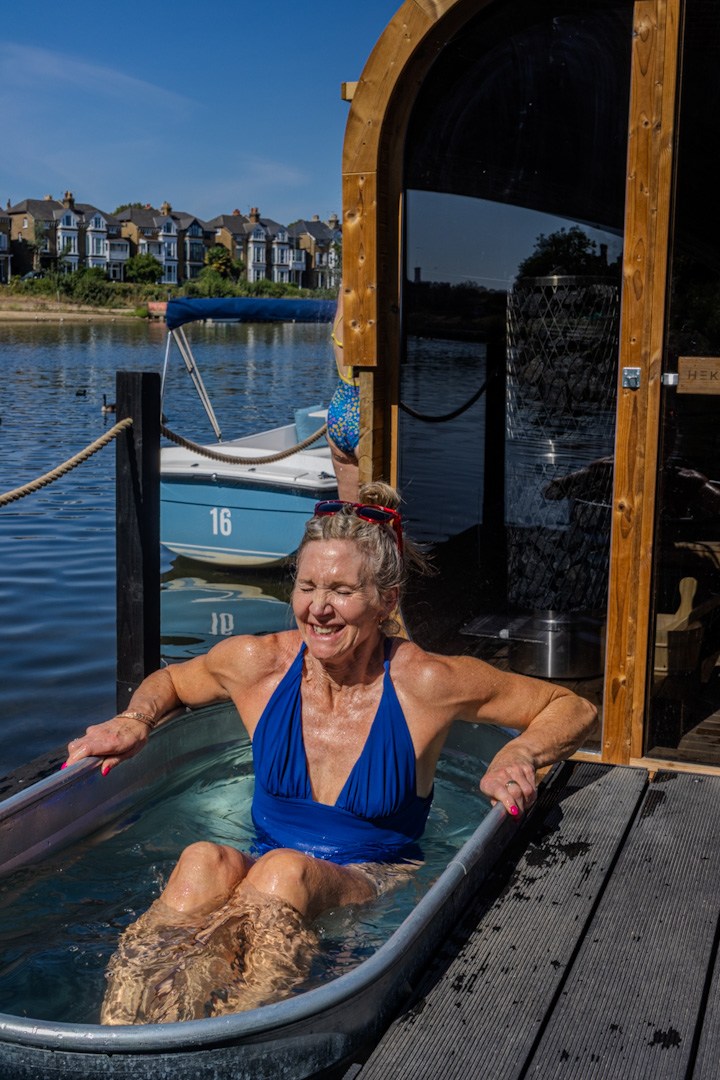
That could mean spending 10-15 minutes relaxing in a Finnish sauna at around 80–100°C before taking a cold shower or submerging yourself in a temperature-controlled ice bath at between 8–10°C.
The process can then be repeated, usually three times during a 50-minute session.
Why is contrast therapy becoming so popular?
For anyone exercising regularly, recovery can be just as important as the workout itself.
Hard training can leave muscles feeling sore and stiff, particularly if you are increasing the intensity of your workouts or introducing new exercises.
Hardy says that, as a former professional rugby player, she knows just how effective recovery techniques can be.
“As a former professional rugby player, I know how hugely effective it is for physical recovery,” she says.
While she admits she once tried to avoid ice baths, the combination of hot and cold temperatures changed her perspective.
“The combination of the cold with the hot takes recovery to another level and leaves you feeling euphoric,” she says.

Can contrast therapy help with muscle soreness?
Hardy says switching between hot and cold temperatures can help reduce the muscle soreness that can follow a demanding gym session.
Heat causes vasodilation, meaning blood vessels widen, while exposure to cold causes vasoconstriction, meaning they narrow.
According to Hardy, this alternating response can support circulation and the lymphatic system.
“Increased blood flow, promoted by the heat, through our aching muscles means an increase in oxygen and nutrients to help speed up our body’s recovery process,” she says.
She adds that the restriction of blood flow caused by cold exposure can reduce swelling and limit the inflammatory response in muscle tissue.
However, the evidence around cold-water immersion and recovery is still developing, and responses can vary from person to person.
How often should you try contrast therapy?
For people who train regularly, Hardy recommends incorporating contrast therapy into a wider recovery routine.
“If you are taking part in fairly intense training three-plus times a week, your body will really thank you for trying to get in at least two sessions a week of contrast therapy,” she says.
She suggests timing a recovery session within 24 hours of your heaviest training day.
The idea is to give your body dedicated recovery time while allowing you to return to your next workout feeling ready to train again.
It is also worth remembering that more is not necessarily better. If you are new to sauna or cold-water exposure, starting gradually and listening to your body is important.
Could contrast therapy benefit your mood?
The appeal of contrast therapy isn’t necessarily limited to aching muscles.
Hardy says that she and her partner, Eddy, have long enjoyed combining sauna and cold plunges, particularly because of the effect they feel it has on their mental wellbeing.
“Not just with our physical health, but also our mental health,” she says.
She believes contrast therapy can help create a feeling of calm after the intensity of the heat and cold.
There is also growing interest in how sauna and cold-water practices may influence stress, mood and the nervous system, although more research is needed before firm conclusions can be drawn about their longer-term mental health benefits.
The appeal of switching off
Perhaps one of the biggest attractions of contrast therapy is that it provides something increasingly difficult to find: time away from your phone.
“In a world where there is so much pressure to do more, contrast therapy, in the form of sauna and ice cold plunge baths, gives you the opportunity to do less,” Hardy says.
“No phone, zero notifications, nowhere to be, just the heat and the cold.”
That combination of physical recovery and time to disconnect could be particularly appealing for anyone whose fitness routine has become another source of pressure.
Hardy also points to the immediate post-sauna “glow” as an added bonus, with increased blood flow leaving the skin looking flushed and rejuvenated.
Is contrast therapy the next big wellness trend?
Research into heat and cold exposure is continuing, with scientists exploring potential effects on areas including cardiovascular health, inflammation and the immune system.
Hardy says research is also underway into whether contrast therapy could have wider health applications, although these potential benefits should not be confused with established evidence.
For now, the biggest appeal may simply be the opportunity to combine recovery with relaxation.
And with wellness increasingly moving towards nature, slower experiences and time away from screens, Hardy believes contrast therapy could become an important part of the next generation of fitness recovery.
“For 2027, nature-led wellness is how we are all going to relax, recover and reconnect,” she says.
Amy Wilson Hardy is the co-founder of TEMZ Floating Saunas www.temzfloatingsaunas.com and a former professional rugby player