

Amy Everett took a trip to the city that invented the spa, discovering the power of the sauna for a good mental reset on a Budapest spa break…
Words: Amy Everett | Images: Amy Everett & W Hotels
I’ve made it my business to keep up with the social sauna trend. Othership in New York has taken communal schvitzing to its logical extreme (I’ve sweltered through comedy nights, therapy sessions and speed-dating). London’s Community Sauna makes the benefits accessible to everyone, whilst Lisbon, where I live, has a growing roster of cold plunge and heat therapy spots (shout out Hot Cold Club and Healthy Horizon).
In Finland, Denmark and Sweden, sauna is a communal psychological practice woven into daily life. I meet travellers the world over, carving out a brief mental reset. When a friend suggested Budapest, I realised this is where it all started.
Baths are to Hungary what saunas are to Finland: democratic, social and even doctor-prescribed. Budapest rests on over 80 mineral-rich thermal springs, where the Romans built baths centuries before wellness became a buzzword. For athletes and active travellers, the mineral-rich water serves as both a cultural ritual and a credible recovery tool. The magnesium and calcium content are known to ease muscle tension, reduce inflammation and support deeper sleep.
I arrived with a race looming, keen to clock up kilometres and major sights. My friend’s idea of a good trip was finishing an entire book in a succession of jacuzzis.
I got out to run before breakfast each morning, ticking off monuments while she snoozed the alarm. The terrain suited me well; the Danube divides the areas of Buda and Pest, the latter almost entirely flat and ideal for tempo runs and longer efforts. Leafy Margaret Island stands between them, its 5km rubberised track offering river views in every direction and a surface that’s kind to the legs.
I crossed to Buda for cobbled streets and serious hill work, building strength you can’t manufacture on a treadmill. Routes varied daily: past the Parliament building (so magnificent Freddie Mercury reportedly asked to buy it on the spot); over the Erzsébet Bridge to the Garden of Philosophers on Gellért Hill. I loved watching the city wake alongside bronze statues of Gandhi, Buddha and other great thinkers.
Crossing all three bridges gives you a sense of conquering the city. The climb to the Hungarian National Gallery is as good a step workout as you’ll find anywhere. A local’s tip saw me jump on a bus to Normafa one afternoon: a quiet forested jog on the city’s outskirts that felt more like active meditation than training.
Budapest, I discovered, takes its running seriously. The city hosts some of Europe’s most celebrated road races: the Wizz Air Budapest Half Marathon in September, the SPAR Budapest Marathon in October, and the Decathlon Budapest Night Run along the illuminated Andrássy Avenue in June, among them. I filed them all away for next time.
Gentle strolls became active recovery between harder efforts, free walking tours a way to piece the city together between sessions. We discovered it scattered with Kolodko statues, tiny bronzes hidden in plain sight by artist Mihály Kolodko (easy to miss when you’re going for your PB). Mr Bean’s teddy bear peeks from the wall of the former British Embassy, ten minutes from our base, Verno House.
Calm and contemporary, its lobby art installation climbs to a vast ceiling, Assouline books scattered below. Flava breakfasts of flaky croissants with tuna mayo, smoked salmon and omelettes (quality protein and carbohydrates) rewarded my early starts. A gym made strength work easy to squeeze in; free bikes had my friend and me matching pace for a sunset ride along the waterfront. A far better active recovery option than a boozy cruise boat.
Meals revolved around the nearby Dorothea Hotel, three 19th and 20th-century buildings redesigned by Piero Lissoni, all heritage staircases and Zsolnay tile walls. Brunch at Pavilon, under a soaring glass roof, spoiled us with roasted meats, seafood, dessert stations and free-flowing local bubbles, a fabulous refuel after another morning on foot.
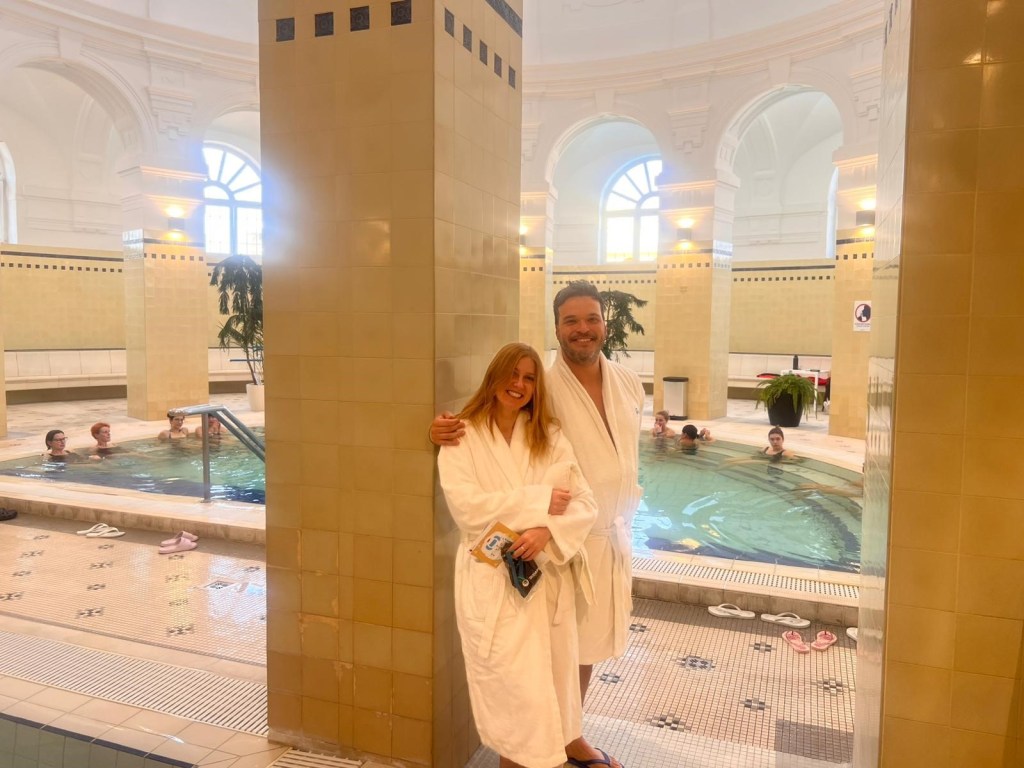
Then the baths. Széchenyi is the place to start: the great yellow Neo-Baroque palace every bit as grand inside as out, a maze of warm and cold plunge pools, saunas and steam rooms that function as a serious recovery circuit if you approach them with intention. After days of hill running and bridge-crossing, it felt like the thermal water was doing something specific, the heat working into joints and muscle groups that stretching alone never quite reaches. I hoped the mineral content might accelerate what would otherwise take days of rest. Either way, we had a ball in the outdoor current pool, a fast-moving swirl where you grab whoever’s nearest and get swept along in inevitable fits of laughter. I came out feeling better than I had in days.
Above it all, a VIP terrace offers fruit plates, coffee and somewhere quiet to lounge. A more boutique bathing option is Rudas: a 16th-century Turkish octagonal pool, hammam and rooftop overlooking the Danube. The deep heat here is particularly good for circulation after long days on foot, with a stillness to it that Széchenyi, for all its grandeur, doesn’t quite offer. Gellért is sophisticated rather than social; Veli Bej is another hidden gem, devoid of crowds. Each offers something different in its recovery toolkit. You’re getting heat for muscle repair, cold plunges for inflammation, and mineral-rich soaks. What the Romans called ‘restoration’ is what sports scientists now call contrast therapy.
Hotel spas worth noting: the Kempinski Corvinus, awarded Hungary’s Best Hotel Spa 2025, with treatment rooms, an indoor pool and sauna opposite Erzsébet Park. AWAY Spa at W Budapest is jaw-droppingly theatrical, its sauna and heated pool inside a Houdini-inspired hall of mirrors within a UNESCO heritage palace (I can’t recall a modern spa experience more glamorous). Back at Verno House, our routine established itself: rinse, sauna, steam, jacuzzi. Getting back to running (and life) without daily spa recovery was an adjustment, no jets to soothe sore calves.
We ate well between soaks – recovery, after all, takes many forms. Candlelit neighbourhood bar Cabrio is the natural wine bar du jour (the devilled eggs have rightly reached cult status – I spotted them on a local’s Hinge profile). Bar Lola draws similar crowds with creative cocktails and pet-nats. For something more classic: chicken paprikash at Pierrot in the Buda Castle district, its guestbook running from Robert De Niro to Ryan Gosling. Try vitello tonnato, then Strozzapreti with beef ragù and gorgonzola at Alelí, Dorothea’s Italian restaurant run by Giorgio, a chef who arrived after the fall of the Iron Curtain. Rooftop Andalusian-Hungarian fusion at Dani García’s BiBo works in ways that shouldn’t: the gulyás (goulash) croquette stealing the show.
Lazy Lion is the spot for Saturday night cocktails, dark and sultry. Pick a mystery drink from a bowl of tickets as the music swells, until you’re ready for a night in the Jewish Quarter. Favouring a good sleep, we nosed around Szimpla Kert during its Sunday morning farmers’ market – our concierge’s tip for enjoying the ruin bar at its least ruinous.
While my friend finished her book, I found myself drawn back across the 5th district to the Dorothea, one last indulgence in an area that had given us so much. Their two-hour Archduchess treatment closed out the trip: a head-to-toe poppy-seed ritual, at one point wrapped in cling film (surprisingly enjoyable), the antioxidant-rich oil deeply nourishing for skin battered by cold air and chlorinated pools. I really did emerge feeling renewed. Muscles still sore but soothed, I slipped into bed before our early flight. Two thousand years of welcoming every kind of traveller; Budapest had known what we needed before we did.