

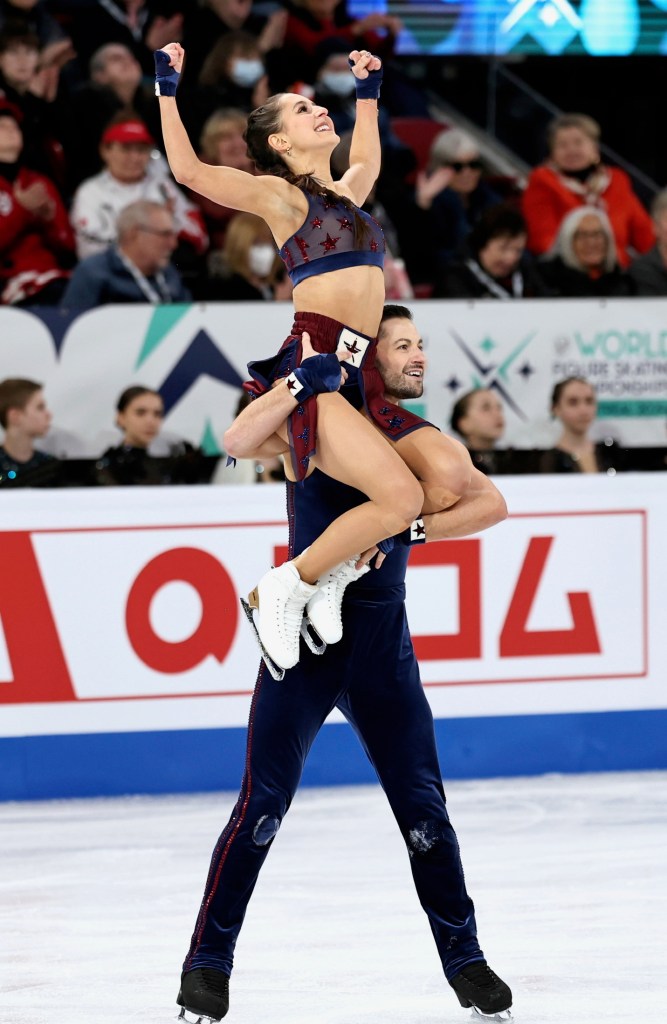
British-Canadian ice dancer Lilah, 26, represents Great Britain with her Scottish skating partner, Lewis Gibson. In March 2025, they won a historic bronze medal at the World Figure Skating Championships, earning Britain’s first podium place in the event in 41 years. The duo is Team GB’s strongest ice dancing Olympic hopes since Torvill and Dean
Words: Joanna Ebsworth | Photography: International Skating Union
Early days
My mum skated competitively until she was 18 and my uncle was a professional ice hockey player who represented Team Canada, so I didn’t really have a choice about skating – I was plopped on the ice when I was two years old! I took part in my first solo competition around the age of six, but when I was nine, I saw the Canadian ice skaters Tessa Virtue and Scott Moir win gold during the 2010 Winter Olympics. That’s the first time I saw ice dancing, and that’s when I announced to my family and declared to the world that my dream was to go to the Olympics and do ice dancing – they’d just have to deal with it!
Ice dance is basically ballroom dancing with a partner on ice, so achieving my dream has been quite the journey, especially as there weren’t many boys to skate with in Britain. I didn’t get my first partner until I was 13, and I didn’t team up with Lewis until I was 16. We were both thrown in at the deep end – he had never danced with a partner before, and I was a very inexperienced junior dancer who had to start competing at senior level because he was 21 – so we had to learn from scratch.
We were competing against people who’d been dancing together longer than I’d been alive, so we were humbled immediately. But the thing that united me and Lewis was the fact that we both really wanted to be Olympians. We had huge aspirations and we were willing to put in the work, no matter what that path looked like. Our real turning point came once we moved to Canada when I was about 17, specifically so we could train at the Ice
Academy of Montreal. It’s been an intense learning curve ever since, but Lewis is my skating soulmate, and I’ve loved the challenge of tapping into our
potential and seeing the growth that’s come from it.

Training
Some people think ice dance looks easy, but I’m here to tell you it’s not. It’s very acrobatic and athletic, and it’s my job to make it look effortless, which is why I train six days a week from 7:30am to 5pm, on and off the ice. I skate with Lewis for four hours a day from Monday to Friday, and also do about
two-to-three hours of off-ice training, plus a full day of off-ice training on Saturday. Off-ice work is very important because there are so many layers to our sport, and it takes a huge holistic approach to create the storytelling performance you see on the ice.
The incredible thing about the academy where we train is there’s a huge coaching team, so we could be practising super technical skating skills one minute or working with a hip-hop dance teacher, acting coach, ballroom coach or lift coach the next. It’s amazing to have so many different insights that we can bring on board to cultivate our performance, but we also have to have strength, flexibility, mobility and grace, so there’s also lots of strength and conditioning, Pilates, cardio, and recovery work.
Another thing I love about ice dance is that every day is different because our choreography is constantly being refined. We usually choreograph our programme in the summer, go out and compete, then increase the difficulty through the season by adding more content following feedback. We’re
constantly collaborating and improving, and there’s no end point of development.
Recovery
My relationship with recovery has changed over the years. I naturally like to fill my time doing things I love – I’m studying for my undergraduate degree in psychology, and my podcast is napping in the lead-up to the Olympics – but I also used to associate my sense of worth with working nonstop. Unfortunately, I had to learn the hard way that rest is productive after I started experiencing hip and back problems and my nervous system became dysregulated.
Now, my favourite hobby is self-care. In terms of physical care, I get acupuncture and massages, have physio once a week, and I use red light therapy regularly to reduce inflammation, pain and stress. I’ve also started doing hot/cold therapy, by alternating the sauna and cold plunge, because it helps with circulation and inflammation. I love the mental challenge, too. Overcoming self-imposed limits when doubt creeps in, and feeling safe in discomfort, is literally a metaphor for performing on the world stage.
Goals
I can’t wait to skate at the European Championships in Sheffield in January 2026, as it will be our first time skating in a championships that’s held in Great Britain. A British team skating two British dances to the Spice Girls and a Scottish medley in front of a British crowd? I get goosebumps just talking about it!
The last time the Europeans were hosted in Sheffield in 2012, I was a flower girl watching my idols dance up close. That inspired me to hope I could be like them one day, and it’s my biggest hope Lewis and I can inspire another generation to get involved in the sport as it’s so much fun.
The ISU Figure Skating European Championships are coming to Sheffield in January 2026. Visit europeans2026.com for more details.