
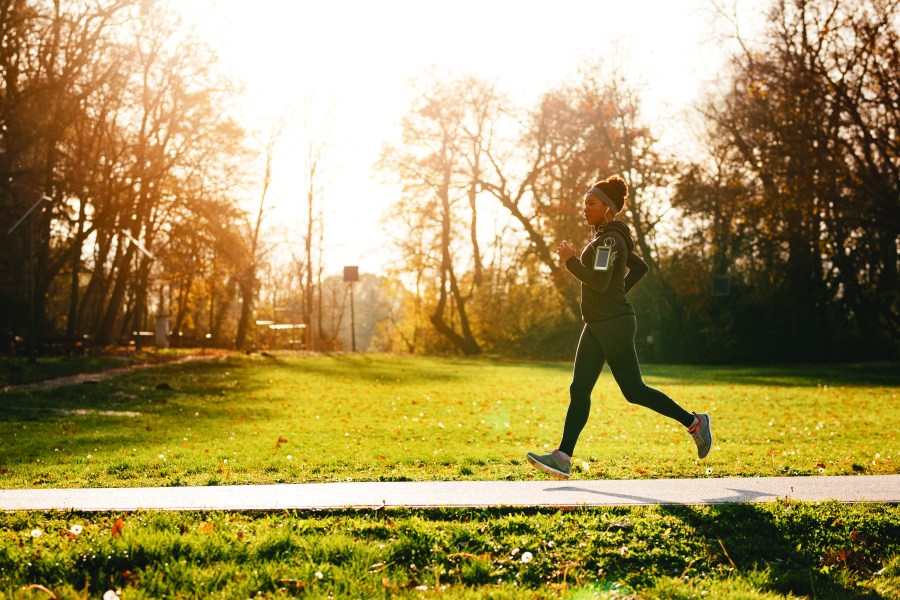
Whether you wish to simply complete or seriously compete, we’ve got the 8-week training plan on how to ace your 5k and get you over the line…
Words: Dean Hodgkin
If you want to perfect your running pace, a 5K series is the perfect thing to sign up for. By regularly putting your fitness to the test, a run series can help you train consistently. The benefits of a 5K is that it is much more palatable than a 10K, half or even full marathon, so it’s a realistic challenge whatever your fitness level.
You might already know of a series near you, or you may join your local parkrun. Celebrating its 21st year, the group run is now held in over 2,000 locations, more than 20 countries, across five continents and with an estimated nine million people registered to take part. The secret to its popularity is that there’s no time limit, making it highly accessible – you can walk, jog or run your way around the course. When you add in the fact that kids, dogs and, on suitable courses, wheelchairs are welcome, it also puts a tick in the inclusivity box.
A strong appeal of a run series is that it will give you a sense of community, satisfying the need for social connection that is hard-wired within our DNA. Indeed, a 2024 study from Manchester Metropolitan University Institute of Sport, published in the journal Social Science and Medicine, showed the group exercise effect to be more fun, promoting a positive identity and a sense of belonging, all of which lead to better mental health.
As a vehicle for shaping up, it provides the most important ingredient for a successful fitness journey – routine! Research has proven that commitment to a regular time and day in your weekly schedule can significantly increase your chances of staying on course.
Connection with nature is now well-established as a tool for managing stress and anxiety due to it being an eco-sensory experience, stimulating your senses in a way the inert gym environment never could, enhancing wellbeing. This is the reason why you don’t have to take part to reap the benefits, just go along and help out! Research at the University of Exeter Medical School discovered that volunteering reduces depression and could even increase your lifespan. It’s win-win all round.
For a walker
Forget the old adage about ‘all the gear but no idea’ as investing in decent footwear, a sports bra and comfy apparel makes good sense. Additionally, never wear anything new on race day unless blisters and chafing is your thing! An amble around the course should take you 60 minutes or maybe a little more, but if you pick up to a brisk pace 45 minutes is a good target. After a few attempts, try interspersing your comfortable pace with 30-60 second bouts of power walking, every five minutes or so. This interval approach will help to burn more calories and accelerate your fitness gains.
Interval: Warm up first with around 5-10mins of jogging, run 400m as fast as you can then allow around 30 secs rest and repeat. Cool down with 5 mins of jogging and then stretch.
Tempo: Run easy for the first 5 mins, continuous fast pace through the middle, then back down to easy pace for the last 10 mins.
Fast: Higher pace than your normal run, you should not be able to hold a conversation, try to imagine you are racing.
Jog: The weekly long run is there to help build endurance and should be at a comfortable pace that allows you to chat to your training partner and/or take in the views.
Rest: You can only train hard if you have sufficient rest between sessions, so make the most of your down-time, perhaps include massage and a gentle yoga class such as yin.
For a jogger
If you can fairly comfortably run one mile then, with some training, you should be able to complete an uninterrupted 5K. Good nutrition will be a great help so, in the weeks leading up to the first event, experiment with different foods, portion sizes and, most importantly, timing, to establish what works for you in terms of how your gut feels. Ensure you take on board enough carbohydrates in the few days immediately prior and get used to hydrating regularly, before, during and after your sessions.
For a runner
If you seek to beat the clock, supplement your run sessions with strength training. Lunges, squats and deadlifts are a given but equally important is to target your core – so take pleasure in doing the plank! Never skip a rest day or, instead of a new PB, the only thing you’ll hit is burnout. Add foam rolling and contrast hot/cold therapy to your downtime. If you need something to aim for, Ciara Mageean holds the record for the fastest parkrun with an amazing time of 15 minutes 13 seconds, achieved at Victoria Park in Belfast in 2023. Interestingly, the fastest men’s time was recorded on the same course, so you know where to head if you feel the need for speed. But whatever you do, don’t set off too fast.